What makes work truly meaningful? And how will artificial intelligence and robotics reshape not only the jobs we do, but also the value and purpose we attach to them? As emerging technologies transform the European labour market, these questions are becoming increasingly relevant, particularly for younger generations preparing to enter a rapidly evolving world of work. They are also at the heart of Meaningful Work in the EU, one of the courses developed within EURAWORK, taught by Francesco Tommasi and Prof. Alberto Pirni, coordinator of the EURAWORK project.
The course explores the future of work from both a structural and a human perspective, examining how technological transformations are changing employment, professional identities, and individuals’ experiences of work. Particular attention is given to the distinction between the concrete changes already taking place in the European labour market and the expectations and assumptions surrounding the future of employment.
A central theme is the concept of meaningful work: what gives work a sense of purpose, and under what conditions can individuals experience their professional activities as valuable and fulfilling? Moving beyond purely economic or technological considerations, the course investigates the subjective dimension of work and the importance of meaning in people’s lived experiences. It also examines the interplay between robotics, artificial intelligence, and meaningful work, highlighting how both organisational factors, such as job design, and individual perceptions contribute to shaping the quality and significance of working life.
These reflections have important implications for education. As part of the course, participating teachers are encouraged to translate theoretical insights into practical educational activities, designing human-centred teaching modules on meaningful work to be introduced in their schools. This approach reflects EURAWORK’s broader ambition to connect academic research with classroom teaching and encourage students to think critically about the kind of working future they want to build.
The course is part of European Union and Digital Transition: The Age of a Renewed Interplay Between Robotics, Artificial Intelligence, and Meaningful Work (EURAWORK), an initiative promoted by the Scuola Superiore Sant’Anna in Pisa, funded by the European Union’s Erasmus+ Jean Monnet programme, and involving five partner schools from Italy, France, Spain, and Romania. By bringing academic research into dialogue with secondary education, the project aims to equip teachers and students with the critical skills needed to navigate the digital transition and reflect on the future of fair, dignified, and meaningful work.
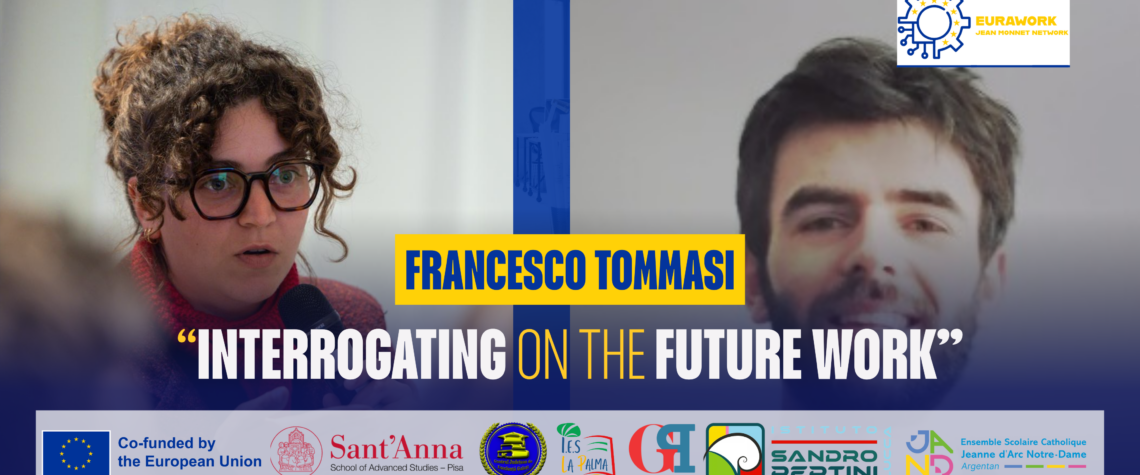
Will technological progress make work more meaningful, or risk undermining its human dimension? What role can education play in preparing young people not only for the jobs of tomorrow, but also for a future in which work remains a source of dignity, identity, and personal fulfilment? In this interview, Francesco Tommasi, one of the EURAWORK lecturers, introduces the key themes of the course developed together with Prof. Alberto Pirni, exploring the relationship between technological innovation, the changing nature of work, and the importance of keeping human experience at the centre of the digital transition.